75th minute. Your team is a goal up. You break away on the counter-attack and then — that sudden spasm in your calf that stops you dead. Five minutes later, your opponents equalise.
If this sounds familiar, you're not alone. Cramps affect a large majority of amateur footballers late in matches. And most of them do exactly the same thing to avoid them: they drink more water, eat a banana before the match, or swallow magnesium tablets. The result: the cramps come back anyway.
That's because everything you've been taught about cramps is wrong — or at least incomplete. Here is what science really says, and how to get rid of them for good.
Cramp is first and foremost a neuromuscular problem — not dehydration
For decades, the standard explanation was simple: you sweat, you lose mineral salts, your muscles seize up. Logical, right?
Except that science has moved on. And recent research seriously challenges this theory.
|
🔬 What the studies say Researchers compared the levels of sodium, potassium, calcium and magnesium in the blood of footballers who cramped and those who did not cramp during the same match. The result: no significant difference between the two groups. Electrolyte levels were similar.
What the studies point to instead is neuromuscular fatigue. When your muscle is exhausted after 70 minutes of intense effort, the signal between your nervous system and your muscle fibre goes haywire. The muscle contracts but no longer receives the order to relax. That's cramp. |
In other words: cramp doesn't happen because you're short of water. It happens because your neuromuscular system is at its limit — and the muscles you've worked hardest (calves, hamstrings and quadriceps for a footballer) can't take any more.
This also explains why cramps always hit the same muscles: the ones you've used the most. Never a muscle that hasn't moved all game.
Why amateur footballers cramp more than pros
Professional players cramp too. But far less often, and far less quickly. Why? Not because they are better hydrated — but because they have better neuromuscular conditioning.
Several factors increase your risk of cramping as an amateur:
– You play at a higher intensity than in your training sessions — the match is always more intense than training, and your neuromuscular system isn't prepared to sustain 90 minutes at that level.
– You have a history of cramps — this is the strongest predictive factor identified by researchers. If you've cramped before, you're at greater risk.
– You play on a different surface from the one you train on — recent studies show that the mechanics of an artificial pitch versus natural grass generate different neuromuscular fatigue, which sets in earlier on unfamiliar surfaces.
– You're short on sleep or you arrive tired — recovery between matches directly determines your resistance to muscle fatigue.
– You're reaching the end of the season — the accumulation of matches without enough recovery gradually drains your neuromuscular reserves.
And what about nutrition? It matters, but not for the reasons you're usually given. It isn't a lack of magnesium that triggers cramp — it's the depletion of your carbohydrate stores (muscle glycogen) that speeds up fatigue, and poor peripheral nutrition that weakens your nerve transmission.
What really works to prevent cramps
The good news: now that we understand the mechanism better, we can act on it effectively. Here is a 3-step protocol.
Before the match — Load your system
The goal isn't to drink litres, but to prepare your neuromuscular transmission to handle 90 minutes of effort.
– Eat complex carbohydrates the day before and on the morning of the match (pasta, rice, sweet potatoes) — your glycogen stores are the fuel for your muscles and delay fatigue.
– Hydrate gradually over the previous 24 hours, not just in the hour before kick-off — cellular hydration doesn't happen in an hour.
– Get enough sleep — neuromuscular recovery relies heavily on deep sleep. A short night before a match doubles your risk of cramping.
|
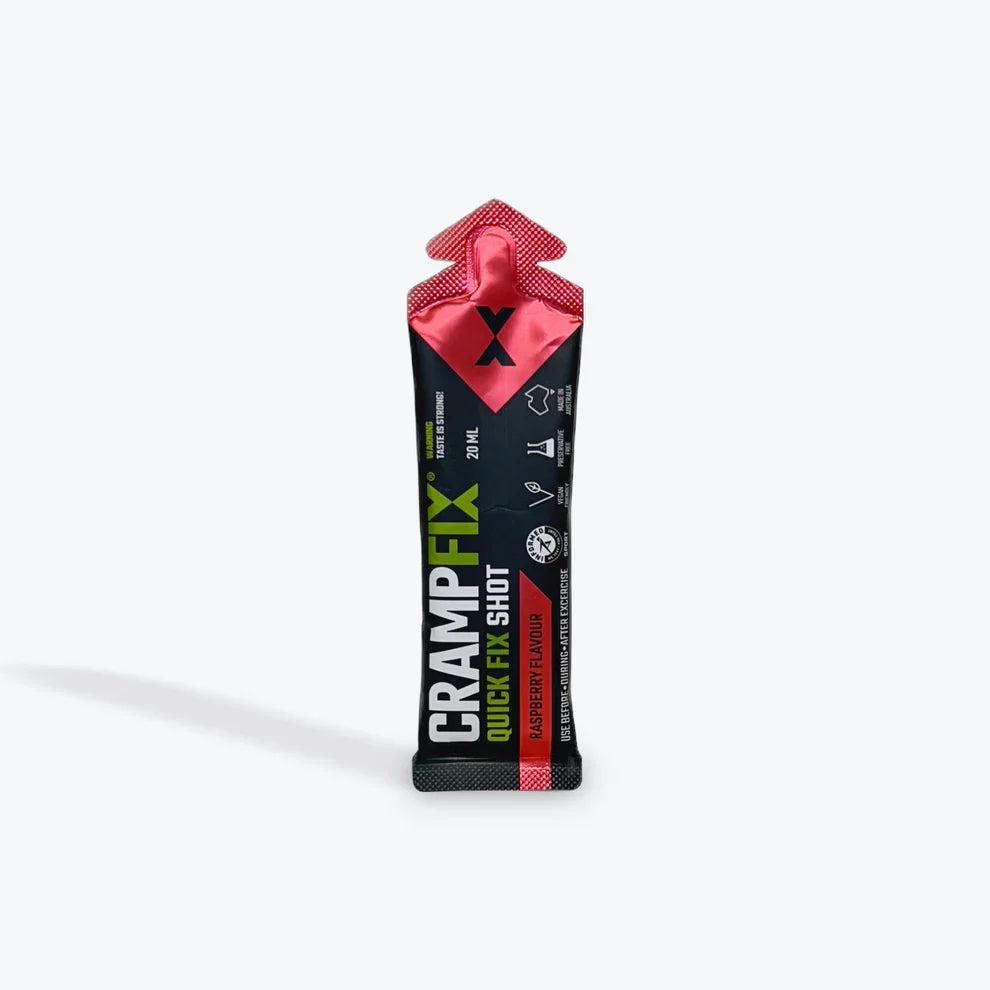
⚡ CRAMPFIX — The Footboks product FOR PREVENTION (before and during the match) → Take CrampFix 30 minutes before the warm-up to saturate your neuromuscular system. → If you feel the first signs (a pulling calf, a tightening thigh), take a dose at half-time. FOR TREATMENT (when cramp strikes) → One dose directly under the tongue. Its action on the nerve receptors in the mouth short-circuits the neuromuscular signal responsible for the contraction — the cramp eases within seconds. Informed Sport certified — no banned substances. Suitable for amateur and professional players alike. |
During the match — Manage your effort
The key is to delay the onset of neuromuscular fatigue, not to fight it once it has set in.
– Don't start too fast at the beginning of the match — the players who cramp earliest are often those who played at an intensity above their usual level in the first 30 minutes.
– At half-time, rehydrate and eat something easy to digest (energy gel, light cereal bar) to partially replenish glycogen.
– If you feel your calf or thigh starting to pull — that early warning signal — that's the moment to act, not to wait for the cramp.
|
⚡ The CrampFix reflex at half-time CrampFix works differently from any electrolyte or magnesium tablet. Its active ingredient triggers a response in the TRP (Transient Receptor Potential) receptors located in your mouth and throat — these receptors send a signal to the central nervous system that "resets" the hyperexcitability of the motor neuron responsible for the cramp.
In plain terms: it short-circuits the faulty nerve signal. No digestion needed, no waiting for minerals to reach the bloodstream. The action is direct, within seconds. |
After the match — Recover so it doesn't happen again
Cramps are also prevented between matches. A player who recovers well between two games is a player whose neuromuscular system is less fragile the following weekend.
– Protein within 30 minutes after the match — the anabolic window is real for muscle repair.
– Gentle passive stretching after the match, nothing intense — the aim is to release built-up tension, not to gain flexibility.
– If possible, 10 minutes of active recovery (light walking, very easy cycling) before stopping completely — it helps clear metabolic waste.
– Sleep — that's when your nervous system really repairs itself.
What doesn't work (and what you're still told to do)
A few myths to debunk once and for all:
|
❌ What doesn't work Eating a banana just before Drinking more water during the match Taking magnesium tablets Stretching before cramp strikes (as prevention) |
✅ What works Loading glycogen the day before Hydrating in the 24 hours before CrampFix for prevention and treatment Improving your physical conditioning |
The banana? The potassium it contains takes too long to be absorbed and used to act on a cramp that's coming in 30 minutes. Water? Drinking too much in the middle of exertion can even be counter-productive — two athletes have died of hyponatraemia while trying to prevent cramps with excessive hydration. Magnesium tablets? Meta-analyses show no significant effect on exercise-related cramps.
The complete action plan to stop cramping
Here is the protocol in summary, week by week:
|
WHEN |
ACTION |
|
Day before the match |
Pasta/rice for dinner · Regular hydration throughout the day · At least 8 hours of sleep |
|
Morning of the match |
Carbohydrate-rich breakfast 3 hours before · CrampFix as prevention (1 dose) |
|
Warm-up |
Gradual activation · Don't go too hard on the first accelerations |
|
Half-time |
Water + CrampFix if signs of muscle fatigue · Energy gel if the match is intense |
|
If cramp strikes |
CrampFix for treatment (1 dose under the tongue) → action within seconds |
|
After the match |
Protein within 30 min · Passive stretching · 10 min active recovery |
|
Week |
Improve your endurance and neuromuscular conditioning in training |
Going further
Cramps are not inevitable. Nor are they a sign that you're not fit enough or that you hydrate badly. They are the symptom of a neuromuscular system that has reached its limit — and that can be worked on, anticipated and managed with the right tools.
CrampFix is designed for exactly that: to act where cramps really start, on the nervous system, not on a hypothetical magnesium deficiency. And if you want to know more about sports nutrition for football, explore our other guides on the Footboks blog.
|
🛒 Discover CrampFix on Footboks Informed Sport certified · Suitable for amateur and professional footballers Available as a single item or in the Footboks Box → footboks.com |